Cognitive Bias in Leadership: What Might You Be Missing?
How often do you find yourself certain of a position, only to sense later thatsomething important was not considered?
Perhaps a decision that felt clear at the time unravelled in the weeks that followed. Or you noticed, almost in passing, that the same challenges keep returning. Or a conversation you thought went well left someone on your team feeling unheard, and you only learned about it much later.
These moments are worth pausing on. They may be pointing to something that most leaders are rarely invited to examine, the patterns shaping how they think, decide, and lead, often without realising it.
When the Lens Narrows
Every leader sees the world through a lens shaped by experience, belief, assumption, and habit. This is part of being human. Over time, however, that lens can narrow without us noticing.
There is an exhaustion that comes with always needing to have the answer. With moving fast, deciding quickly, and projecting certainty even when the situation calls for something more considered.
You begin to favour information that confirms what you already believe, reaching for solutions that have worked before even when the situation calls for something different, and stopping, without realising it, genuinely listening, because somewhere along the way listening began to feel like losing ground.
This could be what cognitive bias looks like from the inside.
It tends not to arrive dramatically or announce itself. Often, it feels like clarity. And yet the people around you may begin to sense it, conversations could lose their honesty, and you, still certain you are right, may not see it coming.
Where It Tends to Take Root
Cognitive bias does not usually arrive as a single moment of poor judgement. It tends to grow gradually, in the same way that a habit forms, through repetition and reinforcement.
Early in a career, the patterns that later become bias may serve a leader well. Moving quickly and decisively builds credibility. Trusting your own judgement when others hesitate demonstrates confidence. Holding high standards signals seriousness and commitment.
Over time, these patterns become automatic. They stop being conscious choices and start being the default. The context changes, the situations become more complex, the people around you have more to offer, yet the patterns remain, carrying the same certainty they always did into territory that may now require something different.
History offers some interesting examples. A Decca Records executive turned down the Beatles in 1962, noting that guitar groups were on their way out.
A senior Nokia executive reportedly described the iPhone as a toy.
Blockbuster passed on buying Netflix, calling it a niche business.
Each was experienced, respected, and completely certain. And certainty, when it goes unexamined, can be one of the most expensive things a leader carries.
It also shows up closer to home, in the phrases that rarely get questioned.
“Why fix things when they are not broken?”
“This is how things have always been done here.”
Most leaders will recognise these. They may also be among the places where thinking has stopped asking questions.
How It May Show Up in Your Leadership
In executive coaching conversations, a few patterns surface with remarkable consistency.
One leader described it simply:
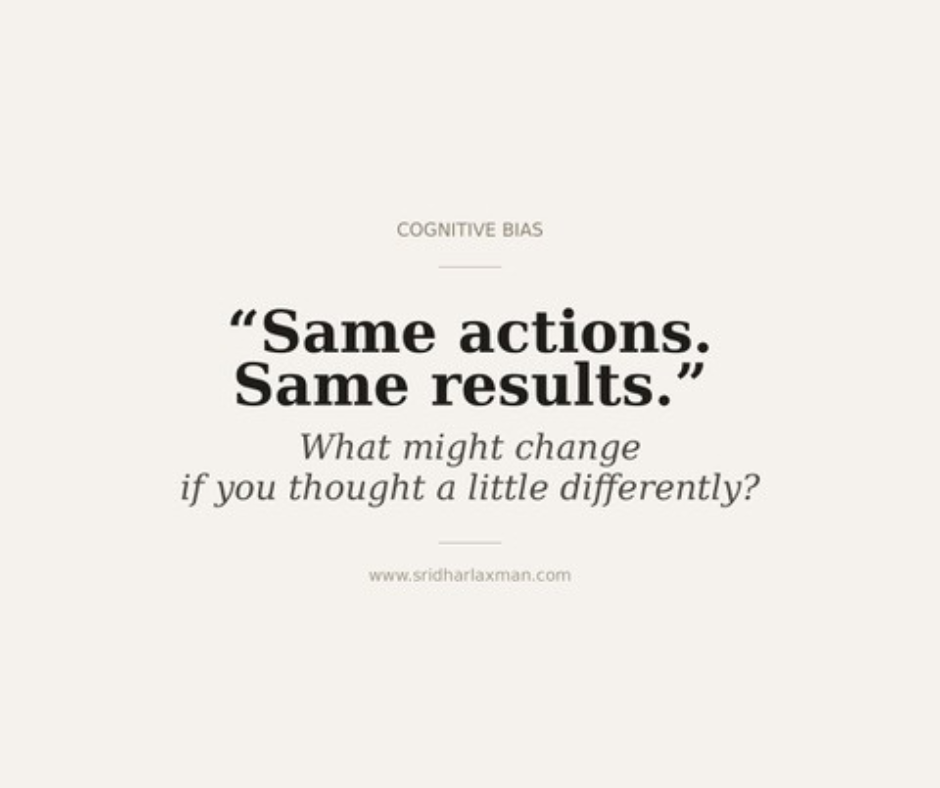
“Same actions, same results.”
He had been leading the same way for years, wondering why things were not changing, why his team felt distant, why the energy in the room had flattened.
When he paused to examine his own thinking, a different picture began to emerge.
Another spoke of what she called:
“Stop enemifying.”
Gradually coming to see colleagues who challenged her as obstacles rather than sources of fresh thinking. In an executive coaching session, she reflected that she had not seen it happening until someone named it for her. By then, she had been leading from a narrower place than she had realised.
Perhaps the most common pattern of all is the unexamined belief:
“I am right, they just cannot see it yet.”
It may feel like conviction. Over time, it could become the distance between a leader and their team.
What It May Cost You and Those You Lead
When bias goes unexamined, the cost tends to be felt before it becomes visible.
People on the receiving end of it describe a particular experience. The sense that the conversation has already been decided before it begins. The feeling of preparing something carefully, only to sense it will not really land. The gradual realisation that honesty carries a risk that agreement does not.
Over time, teams may stop offering their genuine thinking. Decisions could begin to reflect one perspective rather than many.
And the leader, still certain they are right, may not see any of this coming, because the people around them have learned, over time, that certainty is not an invitation.
What Becomes Possible When You Begin to Notice
Awareness, when it arrives, may shift the quality of everything that follows. In executive coaching, this shift tends to be less a dramatic revelation and more a gradual opening, the moment a leader becomes genuinely curious about what they might be missing.
One leader I worked with came to a simple realisation:
“Listening doesn’t mean agreeing.”
In stepping back from the need to be right, he found he could hear his team in a way he had not been able to for some time. Conversations became more honest. People began to contribute more freely, sensing that the room had become safe enough for their genuine thinking. The change was gradual, and it was real.
When you begin to notice the lens through which you have been leading, your strategic thinking may become more expansive. Relationships could deepen. You may find a greater ease in your leadership, one that your team begins to feel in the quality of their engagement and their willingness to contribute their best thinking.
The pause between a situation and your response may be where your clearest leadership begins.
A Few Ways to Begin
Noticing bias tends not to require a significant intervention. It begins with small, deliberate practices.
Pause before responding.
The gap between a situation and your response is where clearer thinking lives. Even a brief pause could change the quality of what follows, and what your team experiences of you as a leader.
Seek the perspective you have been avoiding.
Consider whose voice has been least present in your decisions recently, and find a way to genuinely invite it in. You may be surprised by what you have been missing, and by what it does to a relationship when someone feels truly heard.
Ask a different question.
Rather than “how do I get them to see this my way,” explore “what might I be missing here?” That single shift in framing could open the conversation in ways that agreement never would.
Notice what you reach for under pressure.
Bias tends to surface most clearly in moments of stress and urgency. These moments are worth paying attention to, because they could reveal the patterns that run deepest, and the ones that executive coaching can most powerfully support you in working through.
Invite honest feedback.
Create enough safety for your team to share what they are experiencing, and be willing to hear it with curiosity. What they offer you could be among the most valuable insights you receive as a leader.
Reflections
Take a moment with these questions. There are no right answers. Their value lies in what they surface for you.
Where might you be seeking agreement rather than truth?
Whose perspective have you not paused to genuinely hear?
What patterns in your thinking tend to surface when you are under pressure?
What might become possible if you held your certainty a little more lightly?
What one small shift could you make you
lead with a little more openness?
Certainty is comfortable. Curiosity is where growth tends to live. The leaders who learn to hold both may find that their thinking, and their leadership, keeps expanding.
Exploring these patterns with the support of an executive coach can create the clarity and space to lead with greater intention and awareness.
Connect with me to explore how executive coaching can support you in recognising and working through the patterns that may be shaping your strategic thinking and your leadership.
Related articles
The Leadership Advantage of Asking Better Questions
Leadership Crafts Culture: The Quiet System That Shapes Everything